
By Haley Moore
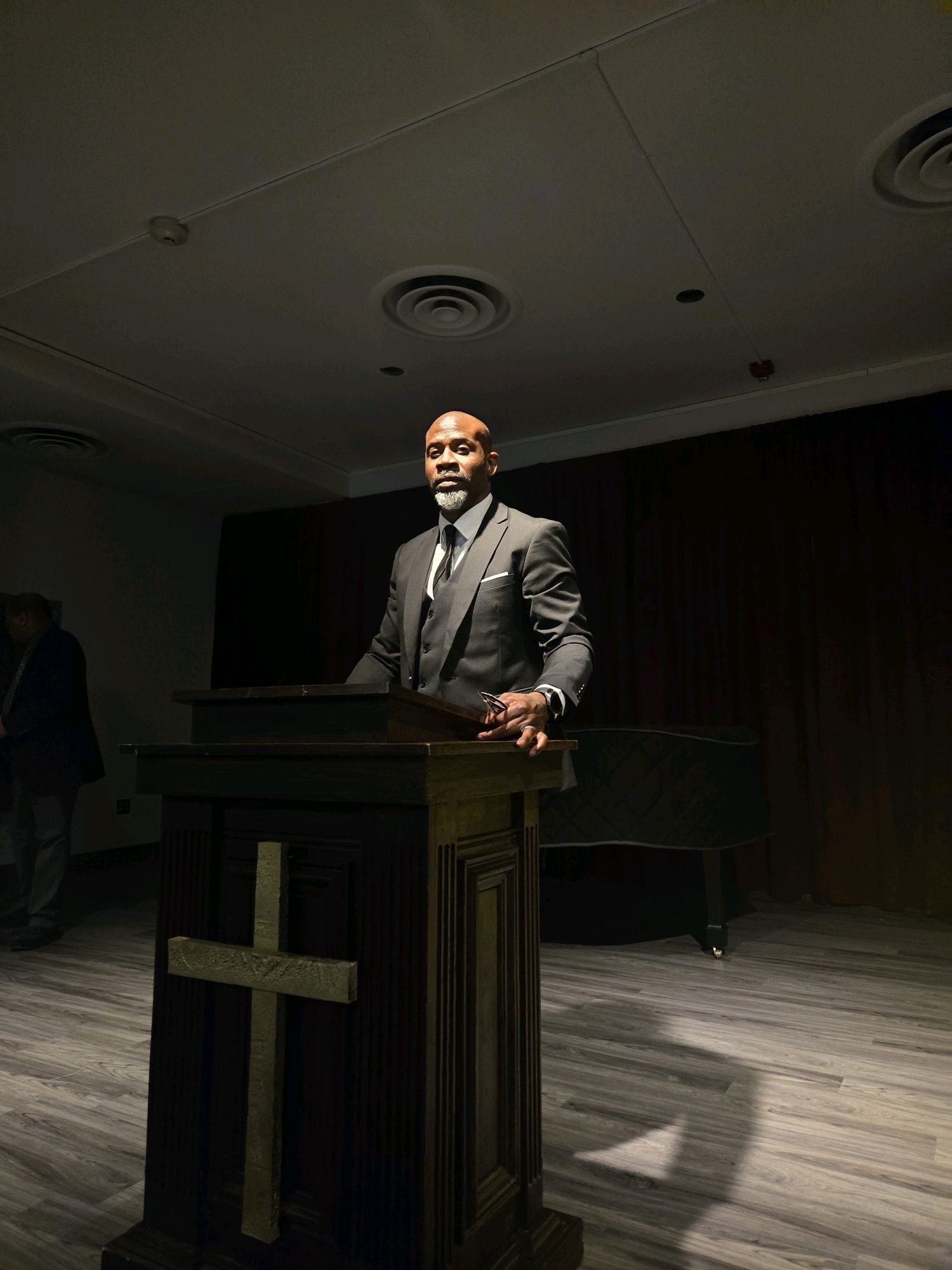
As The James Baldwin Society of NCCU closed out its first year, our faculty advisor, Dr. Al-Tariq Moore, gave a riveting spoken word performance in honor of the organization’s namesake. His performance covered a myriad of topics such as Black identity, sexuality, religion, and the Black experience generally. I was asked to introduce the poet of the evening and, notably, I was nervous but honored. I was nervous because I didn’t want to mess up or disappoint anyone—I had never been asked to do participate in such a way—but I was honored because he chose me to do it, and A Requiem for Jimmy was monumental for the organization.
As a spoken word artist, Dr. Moore performs under the moniker, “Tariq Saint-Sankofa.” “Sankofa” is a West African concept that means “Learn from the Past, or “Go Back and Get It”—whatever “it” may be for the betterment of your present and future self. He lives by that concept and constantly reflects on past experiences in order to make better choices and to manifest his highest and greatest self. “Saint,” acknowledges that one day he, like all of us, will be counted among the ancestors. His hope is that the legacy he leaves, not just in poetry, but in the way that he interacts with and demonstrates the power of love towards others, will be one that his students, friends, and family will one day reflect on—that they will “go back and get” or be nourished by what he leaves behind. Tariq Saint-Sankofa began writing and performing spoken word poetry in 1999 in Raleigh, North Carolina at a monthly event that was then known as “The Cypher.” He describes the birth of his poetic voice in the following way:
“One night I wandered into a bar in downtown Raleigh with no real intention of performing or saying anything. I was drawn in by the sound of Erykah Badu and Music Soulchild blasting from the DJs speakers. This was probably peak Neo-Soul era. I sat at the bar before the event started and the organizer, Tracey Evora, was circulating the room with a clipboard getting people to sign up. We had never met one another before, but when she got to me that night she said, ‘You look like you have something to say.’ And I did. I didn’t know it then, but I did. That was the first time I ever got to hear poets like Dasan Ahanu spit. I was hooked. From there, off and on, I wrote and performed over the years because I liked what poetry allowed me to do—to use my creativity to say meaningful things to artists and people who were primed to listen. I had been writing since my childhood years, but with no serious intention, and I didn’t know this thing called spoken word even existed. After that night, there were long periods where I stopped writing altogether—or perhaps it’s better to say nothing was coming to me because I didn’t know how to listen and wasn’t creatively focused. But the pandemic pushed me back into a space of listening and I picked up my pen and started seriously figuring out what I could do with my voice, experiences, and the knowledge I had gained throughout the years.”
When asked how he conceived A Requiem for Jimmy, Dr. Moore said,
“My writing process is kind of different—or maybe it’s not, I don’t know what others do. I can go for months not writing at all and then one day I wake up in the middle of the night with a line stuck in my head that won’t let me sleep. I grab my phone with the intention of just getting the line down so I don’t lose it. In those moments I’ve been known to end up writing the whole poem half-asleep and not really remembering what I wrote. Then I get up and it’s there and I’m shocked. Honestly, it’s a form of listening that I think the word “channeling” more accurately describes. I don’t think of the poems as ‘mine’—they don’t belong to me; they are voices of others long gone who trust me enough to allow me to transcribe what they want to say. It really does feel like being in dialogue with the dead. When ‘Requiem’ came to me early one Saturday morning, I sat down at my desk and started writing and by the next day I had seventy pages of material and a full-scale spoken word drama production sitting in front of me. I’m still working on it, but that’s how it initially happened. The April 9th show was just seven of the pieces that I singled out to share.”
He says the point of the show is that “Baldwin is still with us, precisely because he was ahead of his time. He still matters. His ideas still resonate. His perspectives still speak to the urgency of now.” On April 9th, Tariq Saint-Sankofa spread the gospel of the James Baldwin’s philosophies of black blues, love, and national identity to a packed crowd of around 63 people in the NCCU Department of Music recital room. We started the evening with 40 chairs available. Then, Dr. Holley, the Chair of the Music Department, brought out another 10, and then there were more students standing around the walls and in the foyer to the room. And the students stayed … through the poetry and into the Q&A session that followed.
Before sharing his first poem,“I Ain’t Always An Artist, Sometimes I Get the Blues,” we heard Nina Simone singing “Strange Fruit” on the speakers, while Dr. Moore stood meditatively gathering himself and summoning the energy he needed to perform. We were silent as we listened to Simone’s blues. Then he started,
“Do me a favor and close your eyes…”
From there, he launched into “How to Honor an Ancestor: An Invocation for Ancestors Suffering from the Symptoms of Unrequited Love.” It was a call to Baldwin to get him in the room with us so he could be properly honored. The remainer of the set would remind us of the uniqueness of what it is to be an “other” in White Supremacist America, as he moved in and out of poems like, “In My Father’s House,” “I Was Made in Harlem,” “Everybody’s Protest Poem, “Lie to Me,” and “Drift Away.” I closed my eyes and allowed myself to feel my otherness. Throughout the show, I imagined myself as the “other” from a time long ago and the “other” from a time yet to come. I think other people in the crowd shared that experience as well. I couldn’t look at anyone’s reactions because that meant I would have to turn in my seat and stare at people like a weirdo, but also because I couldn’t take my eyes from him.
His presence commanded our attention and we graciously gave it. Despite not being able to observe everyone’s reactions, I could feel the nods, the agreements, and the thoughts of the audience members. The energy was palpable and salient. In that room, we weren’t strangers, we were one, united under the powerful words and presence of Tariq Saint-Sankofa.
We were mesmerized by the spirit of James Baldwin’s presence announcing itself through him and haunted by the depth of our own lives and experiences—the experiences we often have but don’t really process because they are so normalized. I could feel the “othering” nuances of my life fighting for recognition—Blackness, Queerness, and The Black Feminine. They raged inside of me as he spoke.
Throughout the show, I kept closing my eyes for little bits thinking of strange fruit hanging from the trees. I imagined myself and the audience as that strange fruit, victims of systems, hanging and waiting to be plucked; waiting for someone to cut us down and consume our meaning; to consume who we are and what we stand for, to eat all of us, even the bitter parts.
Saint-Sankofa spurred all of these new thoughts and discoveries within me. It just took me closing my eyes in the present and going back to the past to get it.
I get it … sometimes we are low-hanging fruit … and we need to be plucked and consumed.
Video footage of the performance is forthcoming. Be on the lookout here on the JBS website for it. If you missed the show this year, don’t worry, Dr. Moore plans to make Requiem an annual event with updated selections and new inclusions each Spring Semester.

Discover more from
Subscribe to get the latest posts sent to your email.

 jbsnccu.com